Friday, February 8, 2013

Bargaining Blunder


     After surviving the Great Wall, our small group had a few minutes before we needed to regroup with our delegation, so we decided to go through the small shops.  We went into one one small store and the contents grabbed my eye.  It was a tiny room packed with all sorts of goods: cheongsams, qipaos, t-shirts that read "I survived the Great Wall," more clothing, fans, stuffed animals, pandas, kid's toys, bookmarks, all sorts of hand-held items, everything--and it was all so very colorful.  I could barely take all of it in, there was just so much. 
     But one particular item caught my eye: a black cheongsam (a Chinese dress that was popular during the 1920-1940s).  It's a beautiful dress that is firm-fitting and typically has slits running along the legs.  I just had to buy it. 
     While I was googling over the dress, a saleslady stood nearby and I figured, 'hey, why not try out speaking Chinese again?'  So I turned to her, gestured to the dress and asked 多少钱?(duo shao qian pronounced "dwoo. shou [shout without the t]. chee-an") which means "how much is it?"  Instead of giving a number, she spoke a very long sentence that I did not understand.  Apparently my blank expression alerted the saleslady that my Chinese was not very good, and she translated to English, saying that I could choose how much to pay. 
      I was kind of shocked... I mean, how much should I have paid for the dress? what was it worth? I had no idea! While I was debating what would be a fair price, I spotted a bamboo fan with a dragon on it.  My older sister would love it.  I picked it up and decided that I would add it with the dress.  But what would be a fair price?
      And I stood there, awkwardly, trying to possibly figure out what a decent price was when my group walked out of the store.  I handed the fan to the saleslady and told her to hold on then I ran out of the store (the exit was on the other side of the store) and hollered to my group that I was still in the store and that I was planning to buy something.
     A girl came up to me and asked me what I was buying and how much I was going to spend on it.  When I confessed that I wasn't sure how much to spend on a dress and a fan, she told me to spend no more than $30 USD.  Funny, because I was debating whether double that would have been an appropriate price.  Then she gave me the advice that if we can't get the price down to $30, that we should walk out of the store.
      It was bargaining.  Before I came to China, that was one of my fears: that I would have to bargain and that  I would be cheated out of a lot of money or that I would cheat someone else out of  a lot of money.
       Yet, there I was, accompanied and bargaining in China.  We walked out of the store several times before finally negotiating the price to what we wanted.  As soon as we reached that price, the saleslady slung the cheongsam across her arm, huffed, and said "fine."  It was a very comical moment that would have fit in a soap opera.  I bit my lip to keep from laughing. 
      She then scurried to the cash register and rung up the order.  The girl who advised me took my camera and said that she wanted evidence in case they charged my credit card the wrong amount.  Yet, when the receipt was printed, it was the correct amount we had agreed on and I signed.  Plus, I gained a really cool photo! Haha
 

Today, I wear the cheongsam a lot.
I'll wear it when I give speeches about
China and I also wear it on Chinese holidays.

Wednesday, January 2, 2013

Surviving the Great Wall

     It's not every day one can say, "I'm on the Great Wall of China!" but on June 23rd 2012, I was able to.
     When we first arrived at one of the entrances to the Great Wall, gift shops and small food stations encompassed us.  To the side was an entrance which went two ways: to the right and to the left.  I was standing before the Great Wall of China and I could hardly believe it.  Phoebe gave us instructions for the next few hours, our rendezvous point, and then we were free to climb the Great Wall of China.  But before we were free, Phoebe advised us: "You can take the right side, which is the hard side, or you can take the left side, which is the harder side.  No matter which side you take, it's going to be hard."
       I grinned at the thought of it: it would be hard and physically exhausting.  I was beyond excited.  We were supposed to stay in small groups, and I found myself with a delegation leader and another boy from our delegation.  The three of us decided to take the left side, the "harder" side. 


      I quickly realized why this side was "harder."  The slope of the ground was ridiculously steep.  I lost my balance several times, stumbling over the loose bricks below my feet.  When the ground wasn't terribly steep, we faced stairs that were thin stairs that covered an even steeper area.  I had to pause many times to gather my breath and regain my strength.  It was disheartening, but I was determined to make it to the tower that loomed ahead of us.  I wasn't the only one who found the climb to be overwhelming.  A young boy was crawling up the stairs as his parents followed, laughing and taking photos of their son.  It was one of the most innocent and heart-warming scenes I had ever seen. 
      Too soon, I realized that the climb was too much for my body.  I was carrying a ten-pound bookbag and the ordeal was taking its toll on me.  I paused again, leaning my bag against the outer wall and closed my eyes, struggling to breathe.


     “Take slow breaths. You’re suffering under the thin air. Breathe slowly,” the boy in our small group said to me as I attempted to control my ragged breathing.
      Of course, I thought to myself. We're in Beijing, in northern China, and I'm on top mountains. Of course the air is thin.
       So there I was, on the Great Wall of China, chanting to myself In…hold…out. In…hold….out. In…hold…out. to regain composure.  And then I thought about the history of this "great wall." 
      In 221BC, Emperor Qin Shi Huang unified China, and became the first emperor to rule over all of China.  In the same year, he ordered that the small walls in northern China be unified into one Great Wall to protect China from northern invaders.  For this to be a reality, prisoners of war, criminals, and poor workers were forced to make this great wall.  The workers often worked until they died.  It's impossible to know how many shed their life building this wall.  For this, the Great Wall is nicknamed, "The Longest Cemetery on Earth."
      Yet here I was, struggling just to walk up that same wall.   With a final deep breath, I pushed myself up and said that I was ready to continue to the tower.  I was nothing, if not determined.
     Between the systematic thoughts of In…hold…out, I imagined prisoners of war and poor workers constructing the bricks to build this seemingly endless wall.  I tried not to visualize the skeletons buried beneath me, but one thought prevailed within my mind: If millions of Chinese could die building this wall, then I could push past my physical exhaustion and climb to the tower.
      As we continued to walk up, I ignored the burning sensation in my legs and my sore back, and remembered a word I learned in Chinese class: 呼吸 (Hūxī, pronounced "who? she?").  It means to breathe.  My teacher had taught us that the word even sounded like a person breathing: huxi, huxi, huxi.  So I began to count my breaths this way--chanting huxi to myself and listening to the soft sound of my breaths.
     If you were standing on a piece of history from 2,000 years ago, what would your thoughts consist of? For me, I did not expect to be chanting to myself, but there I was, atop the Great Wall of China struggling to breathe whilst my legs quivered underneath me.  I’ve never been an active person and an ascent of this magnitude was not easy.


     At long last we arrived at the tower and entered. The weather had been relatively cool; it felt like it was 70* Fahrenheit.  But inside the tower, it was a stone-cooled and chilly atmosphere.  The tower was lined with windows looking out to the great wall.  One near the exit of the tower caught my attention--a couple were looking out over it.  It was very romantic and sweet.  After they left it, the three of us walked to the ledge and took several photos there.  If you looked straight down, it was a steep fall into green grass.  Among the bricks were carved names and dates--in Chinese.  It made me smile.  Turns out that marking your name on monuments is an international taking.


     Too soon, we knew we needed to descend in order to meet back with our delegation at the appointed time, and I looked out over what I had just managed to ascend.  I looked out at the view, and oh, was the struggle worth it! The view stole what breath I had remaining. Smog extended as far as the eye could see, cloaking a truly great wall. I fought back tears and allowed myself to be taken with the image that lay before me. I was on the GREAT WALL OF CHINA. This wasn't a sweet dream that I would be awakened from; this was reality. This was a dream come true.


     Fortunately, I had gained composure before we began to descend.  I quickly discovered that the descent was much more difficult.  I grasped the rusting rail and focused on taking one step at a time.  My legs began to buckle underneath me and I began to worry; would we make it back to the rendezvous on time? I pushed the thought away and concentrated on breathing again and going as fast as I possibly could down the steep stairs.  I kept my eyes trained on my feet and prayed that I wouldn't trip.
      The next time I looked up, I realized that the boy and the delegation leader had evanesced from my sight.  I immediately panicked; had I been that slow?! Had they been able to walk so much faster that they were so far away? 
     I swallowed my hysteria and looked back down at my feet as I pressed on.  Panicking wouldn't benefit me--I needed to get back to the rendezvous.  I gripped the rusting rail with all my might, but fear was lodged within me.  I didn't know where the others were, and I have terrible balance.  These steps were begging for my demise.  I took the steps with both feet.  I felt childish and young, but I knew if I persisted, I would make it. 
     The next time I looked up, I still didn't see either the boy nor the leader.  I wasn't focused on breathing, and my mind wasn't on the history of the Great Wall.  I wanted nothing more than to sit down and rest, but I pushed on.  I was completely focused on the steps when out of no where a hand reached up to me.  Shocked, I looked up to see the leader giving her hand to me.  She was going to help me down.
      Blood rushed to my cheeks as I was both relieved and embarrassed, but mostly I was grateful for the help. 
      I then felt the weight of my ten-pound backpack lift off my back.  I gasped in relief and shock that the boy was also helping me. Waves of emotion and gratitude washed over me.  I had been raised to believe that the world is a bad place full of bad people, yet here were two people I barely knew, helping me descend the Great Wall of China!  It was the most humbling and wonderful experience I have ever experienced in my life.
      Never in my wildest dreams had I imagined that someone--two someones!--would be kind enough to help me descend the Great Wall.  I truly witnessed the heart of humanity.  I had never been so touched in my life.


     Time was a strange creature. It seemed as if it wasn't passing yet was passing with incredible speed at the same time. Somehow, we all managed to overcome the steepest part (the stairs), and I nodded to the leader and she released my hand.  I also turned my head and said 谢谢 (xie xie, pronounced she-ya she-ya; which means thank-you) and my bag slumped against my body.  A moment later, and the boy came to walk beside me. 
     It could have been a scene from a movie, it felt so.....right.


        A few hours later, as our delegation was on the bus, I turned to the boy who had helped me and said “thank-you, thank-you, thank-you for helping me! I cannot explain what that meant to me.”
      He blinked a few times and gave me a strange look before saying, “Stephanie…. That wasn’t me. That was some random Asian guy.”


The Truth From a Stranger


    Day Two and the highlight of today would be going to the Great Wall of China.  But before we were to go there, our first stop was at a cloisonne factory.  While the Great Wall was definitely what I was looking forward to, I knew that the factory would be a great learning experience.  I had never been to a factory before, and I wasn't exactly sure what to expect. 
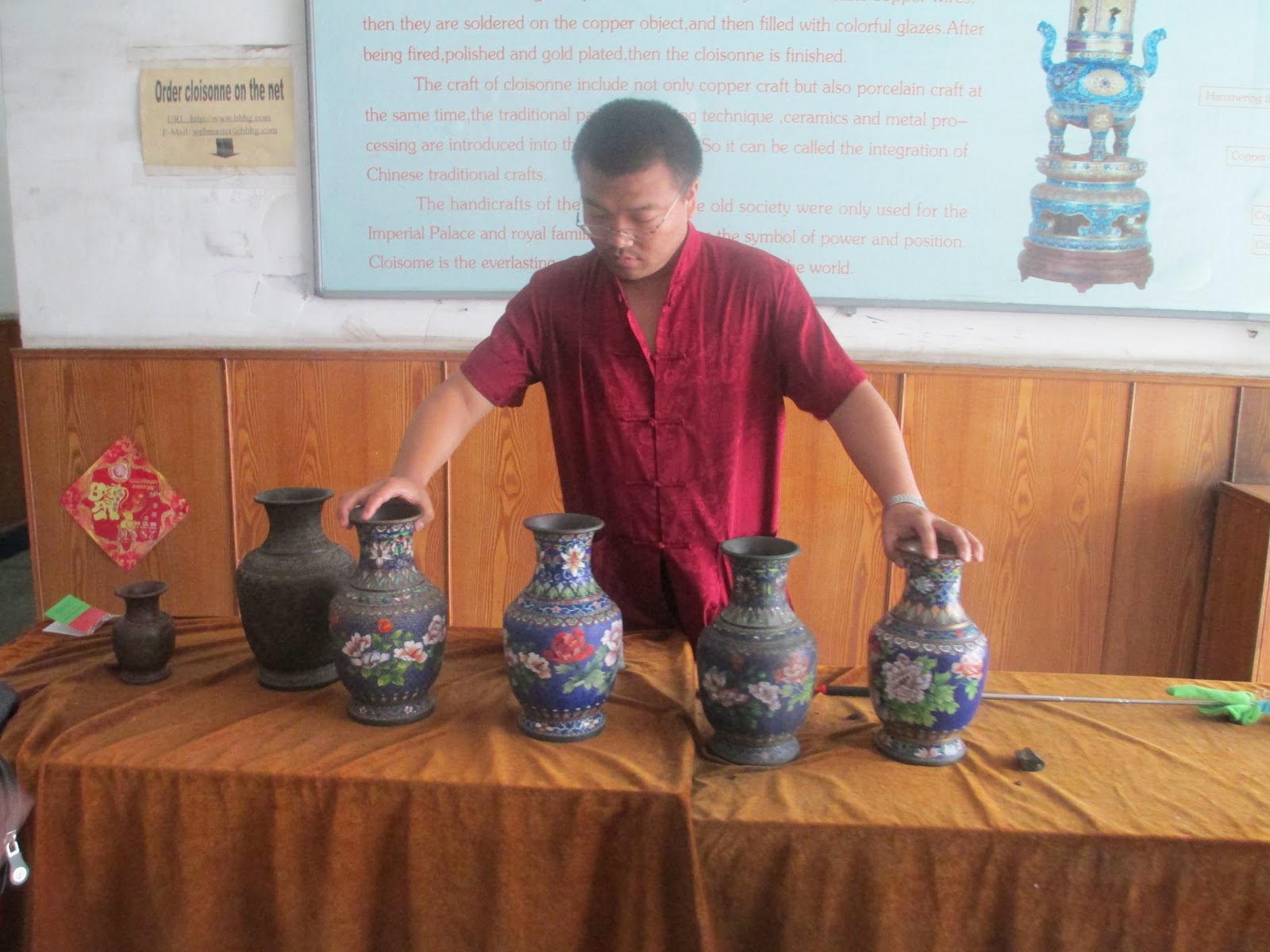
     When we arrived, we first came into a cool, refreshing building with sparkling, tiled floor.  There was a large open space before it branched off into two directions (left and right).  But within the expanse was a table with five vases on it.  Behind the table was a man who would explain to us the process of how cloisonne is made. 


     Cloisonne is a type of pottery.  It is an expensive type of pottery, but exquisitely beautiful.  At the factory, we learned about it: It takes forty-five days to make your typical cloisonne. There are three main steps in the process:
1. Add wiring.
2. Fill wiring.
3. Put it into a kiln.


     The first step is to take a piece of piece of copper pottery and glue metal wiring over it to form a design.  These wires are formed by factory workers and can be anything from lines to shapes(flowers, panda bears, et cetera).   After the wiring was glued to the pottery, it would be ready for the next step:
     With the wires secure, workers would take colorful sand and fill in the holes that were made.  The colors are typically bright and beautiful.  After the pottery is coated with sand, it will go into a kiln and be baked. 
     The second and third steps would then be repeated until the metal wires were covered completely with sand.  (It would take many layers for the sand to cloak the metal wires).  This is the process which takes cloisonne so long to be made--it can take months, depending on the size of the work of art, to be completed.


      The rooms we visited were dimly lit and contained anywhere from two to four workers working laboriously.  The air in this part of the factory was thick; there was no air-conditioning; only electrical fans.  I had heard the term sweat-shops before, and I wondered if this was what that meant.


     In a corner of the wire room were finished products waiting for the next step.  Some of them were huge and were strange objects--large eggs, and other things that aren't your typical pottery. 
     We then went to the sand room.  It was there that I learned something important...
     While in my stay in China, I wanted to take as many photos as possible to bring back with me.  Maybe it was to prove to myself that going to China had actually happened--that it wasn't just a wonderful dream.  I took over five hundred photos within my first two days of being in China.  With this motive, I took many photos within the factory.  Within the colored sand room, I took a photo of a worker and after the photo took, the worker looked up at me with hurt eyes.  Her expression portrayed a sad annoyance and thoughts that spoke of foreigners who could never understand her hardships.  I lowered my camera, but before I could speak an apology, our delegation pushed me forward.  Out of respect, I am not posting the photo with her in it.  After that experience, I refuse to take photos of workers. 
     She had seen me as a tourist who didn't know better, who couldn't know what it meant to work hard and never be able to make progress.  And maybe that was true.  And the truth can hurt. 
 
 
     After the sand room, we walked outside to the kiln.  The surrounding buildings were cloaked in vines and vegetation.  The buildings were well-maintained and I thought that this was odd.  Back in the States, if a building was covered in vegetation, it was usually an old building.  Yet, I had once seen a documentation supporting solar energy that talked about buildings being a basis for vegetation--the roof would be covered in grass and the sides would be coated in vines.  Maybe these buildings were eco-friendly?


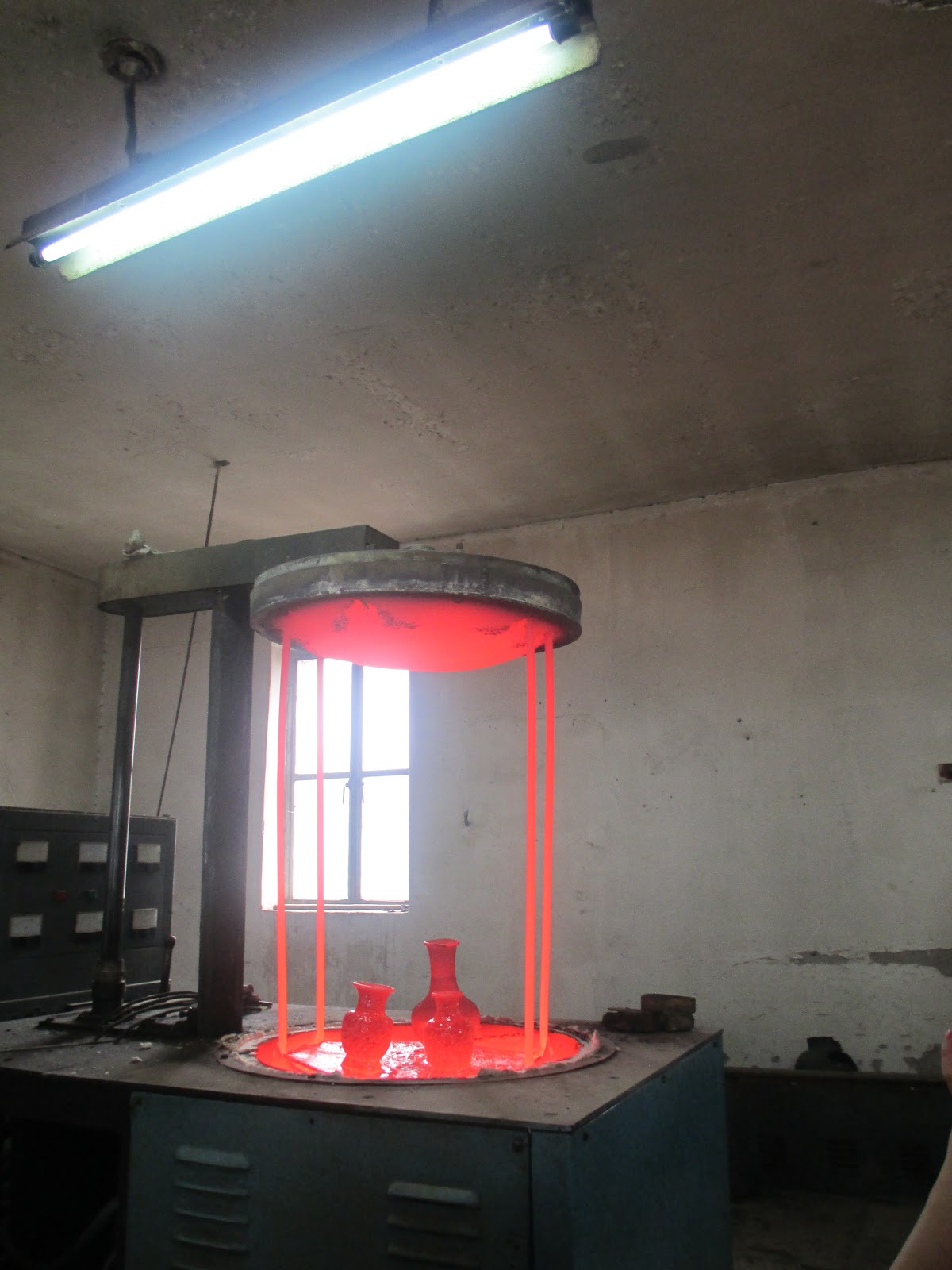
     Once the pottery was ready to go into the kiln, they would be transported to a shed-like building where they would be fired up to 800* Fahrenheit.  We were able to see the kiln raise up, and felt the vast heat blaze against our faces in the already hot and humid temperature.  When we left the kiln room, I remember feeling a rush of cold in the eighty-degree outside.
     The last part of the tour consisted of our delegation being able to put sand into a wired piece of pottery.  The sand would be put between wires using an eye-dropper.  There was a variety of colors and the experience of making it come to life was calm and thought-numbing.


Monday, December 31, 2012

Behind the Zodiac

     The first day was coming to an end, and evening was descending upon us as we made our way to our last destination before returning to our hotel: dinner.
     A notorious dish in Beijing is Peking Duck, so we went to a small restaurant that prepared the famous dish.  Again, as a vegetarian, I was worried.  I'd had two meals in China thus far and they were great, but the plane ride here had been disastrous... How would this meal end?
     When we arrived at the restaurant, I was shocked by how small it was.  The first restaurant was, what seemed to me, a five-star restaurant.  It was in a two-story building and was incredibly elaborate, whereas this restaurant was a small building and we were on the first floor with crowded tables.  Like lunch and breakfast, the dinner tables were round and contained a lazy-susan top. 
     But on top of these tables, aside from our dishware, were laminated pieces of paper that contained the Chinese zodiac, the animal, the years, and some characteristics of the animal. I watched as other delegates learned about their Chinese zodiac. 
     In Chinese class at school, we had learned a lesson on the Chinese zodiac, and even learned about the legend behind the zodiac.  I knew that I was a pig--born in 1995.  In class, we had to memorize the order of the Chinese zodiac:
1. 鼠 (shu, pronounced "shoe") Rat
2. 牛 (niu, pronounced "knee-oh") Ox
3. 虎(hu, pronounced "who?") Tiger
4. 兔 (tu, pronounced "two") Rabbit
5. 龙 (long, pronounced "long") Dragon
6. 蛇 (she, pronounced "shut" without the "t") Snake
7. 马 (ma, pronounced "ma") Horse
8. 羊 (yang, pronounced "yawng") Sheep
9. 猴子 (hou zi, pronounced "hoe-tsi") Monkey
10. 鸡 (ji, pronounced "gee") Rooster
11. 狗 (gou, pronounced "go") Dog
12. 猪(zhu, pronounced "jew") Pig

     If you want to learn more about the Chinese zodiac and about which animal you are, I highly recommend you read this page: link
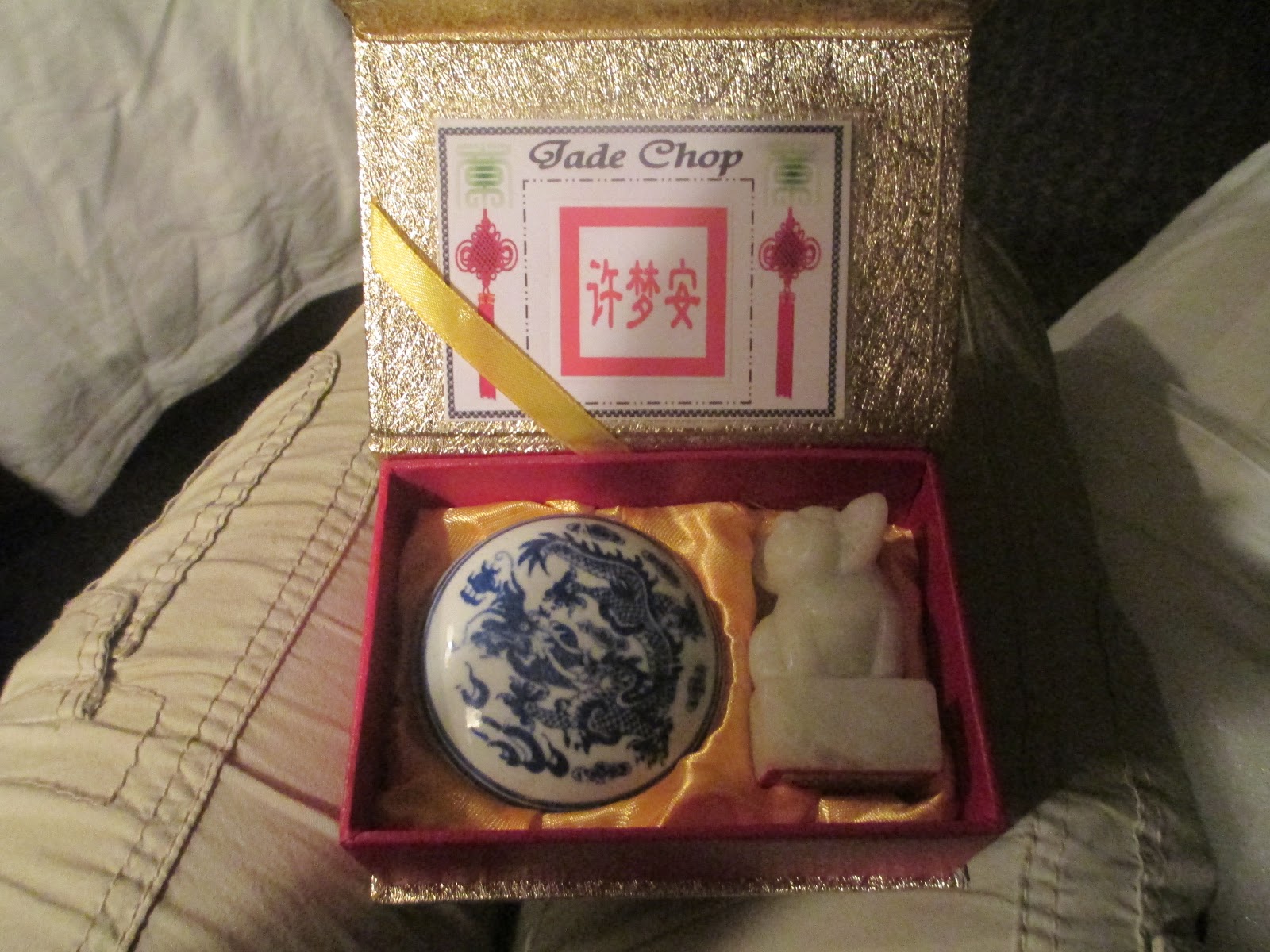
     Phoebe announced that we could order and buy a Chinese stamp with our Chinese zodiac and Chinese name.  Earlier, Phoebe had given us name tags with a Chinese name that fitted phonetically with our original name.  On the back of the card was her contact information.  When my American name, Stephanie, is translated to Chinese, it means gibberish; so, I decided to go with my original Chinese name I had selected from Chinese class: 许梦安 (Xu Meng An, pronounced "Shoe Mung On") which means Promise Dream Safe.  In Chinese culture, the surname is placed first, to show respect for your ancestors.  During the trip to China, everyone called me Meng. 
     So I decided that I would buy a Chinese stamp with my zodiac (the pig) with my original Chinese name on it.  This was my first purchase in China, and I was thrilled it would be a stamp.
     Phoebe explained to us that stamps in China were highly revered.  Once you are an adult, it is "required" of you to have an official seal.  Originally, only the emperor was permitted to have a seal, but then it spread out over the twentieth century to higher officials, and then today to all people. 
     My seal arrived the next night.


On the left is the red ink, and on the left is my seal.


     My worries about food were put to rest: plenty of vegetables were available.  Many students from our delegation were adamant about not eating duck, though.  I was becoming more and more trusting of the foreign food.  Better yet--I was really enjoying Chinese food.  I had only had take-out Chinese food once in my life before, and I had hated it.  This authentic Chinese food was fifty thousand times better. 
     

Monday, December 24, 2012

Culinary School

     After lunch, we drove to a culinary school, which is a vocational school/college.  Once inside the building, we were brought into a small room in order to participate in a tea ceremony. 

 
     The ceremony was held by female students at the school while their teacher supervised. There were two main girls that conducted the ceremony while other students passed out cups and poured the tea. In the photo below, the girl on the left read, in English, a brief history on tea and what types of tea we would be sampling. We tried four types of tea. While her English was articulated and loud, she sounded robotic, even when she was not reading off of the paper. The girl on the right would prepare the tea, pour the tea, et cetera. She was very elegant and graceful in her moves. It was as if she was as elegant as a beautiful swan. It was inspiring to watch.


     After the tea ceremony, our delegation was split into two groups to go to the kitchens and prepare different dishes.  In the group I went to, we made roses out of dough.  We were first under the impression that they were edible; however, they were not.  You could either make yellow or red roses.  Now that I think of it, I find it interesting because red and yellow are both auspicious colors in Chinese culture. 
 
 
     The roses were actually difficult to make.  I am not physically artistic and crafting a rose from modeling dough was frustrating.  First we had small blocks of dough that we had to roll out into flat, round pieces.  Of course, I was the one unfortunate enough to pick out the driest blocks of dough, and had to start over with new dough.  But once I had dough pieces with enough water, the process was much easier. 
      After rolling out the dough pieces, you had to pick one and roll it into the center of the rose.  Then, you had to place other flattened pieces around the rolled ones, expanding it until it looked like the flower part of a rose. 
     When the rose flower was as thick as you wanted it, you would add a leaf to it.  The leaf was rolled out flat like the other flower pieces.  You would use a toothpick to make the indentions to look like a leaf.  Then, when complete, you would stick the toothpick into the rose and voila! Rose is complete.
     Our two groups then switched rooms.  The next activity we had was to make dumplings! ....pork dumplings.... As a vegetarian, I decided to watch as the other delegates made dumplings from scratch.  While watching the other delegates make the dumplings, I spoke with Phoebe.  Turns out she is also a vegetarian!
    
 
     While in the dumpling room, I was shocked to discover that there were two Chinese boys, approximately my age, goofing off.  They would playfully slap each other on the back of the head, would argue over who would collect (and who would cook) the dumplings.  It was childish and completely unexpected, but it also proved a point: People are people literally everywhere you go.  Westerners typically have the assumptions that Asians are studious, hard-working students who make straight-As and never enjoy themselves.  But that's not true! Stereotypes are just stereotypes.  People of any culture can stand outside their stereotype.  That's what makes us human: we are all different from society's expectation. 


Thursday, November 29, 2012

Lunch


       Our next destination was a restaurant for lunch.  The memory of the mother and her child haunted me and I could only nibble on food while listening to those around me chatter. 
       When we entered the restaurant, I noticed how it was such a fine, beautiful restaurant.  After we walked in, our delegation walked upstairs and were separated into four rooms.  In the room I was in, the room was a near perfect square with a table in the center and a window taking up most of the adjacent wall.  There were two elegant, cushioned chairs beside the window.  The floors were carpeted.  It was truly gorgeous.
       I had never been in a five-star (er, four-star?) restaurant before in my life.  The closest I had to anything like this were the graduatioin banquets from fifth and eighth grade.  It was different, being in such a fancy restaurant. 
       The table was situated in the middle of the room and featured a lazy-susan.  A lazy-susan is a turning-table that food will be placed on a circular table.  It makes it easier to access food because you can spin it to the dish you want.
       I had not been looking forward to using the lazy-susan prior to  traveling to China because, traditionally, one would use their chopsticks to pick up food from the plates on the lazy-susan.  I was still a semi-germophobe and sharing dishes with other people's used chopsticks was not appealing to me.  This fear was broken whenever the waiters placed dispensing utensils alongside the dishes. 
        When the dishes came out, I was glad to see some vegetarian options.  There was actually another vegetarian within our delegation, I was happy to learn at lunch.  We also had three options for beverages: Sprite, Coca-Cola, or bottled water.  (Because of the pollution in China, tap water is not safe to drink.  When we traveled places, we always carried bottled water with us instead of refillable water bottles).  The options of Sprite, Coca-Cola, and bottled water became our only beverage choices during lunch and dinner for the next eighteen days.
      
Rice, tofu, cooked cabbage, and asparagus


       Lunch quickly became fun when everyone picked up their chopsticks.  Some could use them with ease, others could not and struggled to pick up anything at all.  It was quite comical.  Some people eventually caved in and asked for a fork.
 
       I had taught myself how to eat with chopsticks when I first entered high school.  I had put them in my right hand and would force myself to pick up food to train myself how to use them.  Often times I would pop a bag of popcorn and eat it with chopsticks.  If the popcorn grew cold before I could finish it, so be it.  I was stubborn in my way to learn how to eat with chopsticks.
       When I was in Chinese class at school, we had a competition with chopsticks.  We had to use chopsticks to pass a ping-pong ball through a line of people then run around the classroom to the finish line without dropping the ping-pong ball.  It was extremely difficult but also tons of fun.  Each team dropped the ping-pong ball several times and the sound of it bouncing against the hard floor resonated within screams and yells within the groups.  It was extremely fun.
        But before we began the game, Zhang 老师 (laoshi, or teacher Zhang) went around to see how everyone held their chopsticks.  To my utter devastation, Zhang 老师 told me that I was holding my chopsticks wrong.  I was shown how to hold them correctly, and I had to reteach myself how to hold chopsticks.  This was a few months before my departure to China.  I was scared that I would never relearn quickly enough to use chopsticks in China. I began to use chopsticks for every meal.  I would be disheartened easily when my meal became cold, and I would revert back to using chopsticks incorrectly to finish my meal.  But eventually I gained the knack of it and I was able, over several moths, to eat with chopsticks properly and efficiently.  To this day I still enjoy eating popcorn with chopsticks.
       After Zhang 老师 had seen how everyone held their chopsticks, she told us something unique.  Where you hold your chopsticks indicates how far away your soul-mate lives.  If you hold them close to the base, your soul-mate will live in the same state, if it's farther up, your soul-mate could live in the same country.  If your hand is toward the middle, your soul-mate will live in a different country.  If your hand is at the top of the chopsticks, your soul-mate would live across the world. 
       When I held the chopsticks the incorrect way, my hand rested at the very top of the chopsticks.  (An indication that my soul-mate lives in China, perhaps? ;) However, when I held the chopsticks correctly, my hand rested just above midway.  Who knows what that means? Maybe I have two soul-mates? Haha.


     After lunch, we were leaving and one of the waiters came in to clean off the table.  As I was about to leave the room, I said 再见(zaijian, or goodbye) to the waiter.  He nodded his head and also said 再见.  I smiled and left the room.
       Before him, every time I said anything in Chinese to someone Chinese, they would reply in English.  It was disheartening and I began to wonder if my Chinese was not good enough.  But when the waiter also said goodbye, I knew that at least he could understand me.  I began to gain more confidence within myself.

Thursday, November 22, 2012

Images to Never Forget

       After exiting the Forbidden City, Phoebe instructed us that we would walk to our bus where it was parked a few blocks away.  She forewarned us that along  our way, we would encounter more vendors as well as beggars.  Phoebe advised us to avoid eye-contact and to not give away money. From previous experiences in the morning, we learned that vendors would sell cheap products for a cheap price.  However, we had not yet seen beggars.  The thought frightened me; I have a soft heart and I cry easily.  I wasn't sure how I would react.  Phoebe instructed us to not look at the beggars.
       Earlier that day, I had learned how to stay away from a vendor's path.  When they wave their products at you, the best thing was to look down at your shoes, shake your head once, and dismiss them lightly with your hand, whispering or mouthing 不要.  They would then move on to another person.  不要, bu yao, translates to "don't want."  It may seem rude to say that, but it's really not.  Most Chinese sentences are short phrases that contain only essential words.
       While we were walking to the bus, we passed a strip of sidewalk that literally held a line of beggars.  I kept my eyes trained on the back of the head of the student in front of me, but I could still hear the beggars begging for money.  There were musicians and singers and people crying and wailing.  I tried to ignore them.
       However, as we veered a corner there was a mother crying, begging for help.  She held her son, a toddler boy who had either passed out or was asleep.  She held her son with both arms, her face desperate for any kind of help.  His head lolled over her right arm, his face was discolored.  He had to be deathly ill.  I quickly looked away, biting down hard on my lip, tears brimming in my eyes. 
       I truly was not prepared for this.  But then again, this is not about me. 
       Yet it touched a cord within me.  Here I was, fortunate enough to be studying abroad in China, while there were people standing and sitting around me who may or may not be able to eat tonight, tomorrow or possibly ever again..... 
       It makes you think about what you have--no matter what you have or lack.  And it's a reason to be thankful.  There is so much in life we take for granted: food, shelter, water, friends, education, you name it.
        The image of the mother with her child is something that has haunted my mind daily since that day.  It's not something you can forget about easily.  And it is not something I want to forget about.  Sometimes you need to be humbled.