Monday, December 31, 2012

Behind the Zodiac

     The first day was coming to an end, and evening was descending upon us as we made our way to our last destination before returning to our hotel: dinner.
     A notorious dish in Beijing is Peking Duck, so we went to a small restaurant that prepared the famous dish.  Again, as a vegetarian, I was worried.  I'd had two meals in China thus far and they were great, but the plane ride here had been disastrous... How would this meal end?
     When we arrived at the restaurant, I was shocked by how small it was.  The first restaurant was, what seemed to me, a five-star restaurant.  It was in a two-story building and was incredibly elaborate, whereas this restaurant was a small building and we were on the first floor with crowded tables.  Like lunch and breakfast, the dinner tables were round and contained a lazy-susan top. 
     But on top of these tables, aside from our dishware, were laminated pieces of paper that contained the Chinese zodiac, the animal, the years, and some characteristics of the animal. I watched as other delegates learned about their Chinese zodiac. 
     In Chinese class at school, we had learned a lesson on the Chinese zodiac, and even learned about the legend behind the zodiac.  I knew that I was a pig--born in 1995.  In class, we had to memorize the order of the Chinese zodiac:
1. 鼠 (shu, pronounced "shoe") Rat
2. 牛 (niu, pronounced "knee-oh") Ox
3. 虎(hu, pronounced "who?") Tiger
4. 兔 (tu, pronounced "two") Rabbit
5. 龙 (long, pronounced "long") Dragon
6. 蛇 (she, pronounced "shut" without the "t") Snake
7. 马 (ma, pronounced "ma") Horse
8. 羊 (yang, pronounced "yawng") Sheep
9. 猴子 (hou zi, pronounced "hoe-tsi") Monkey
10. 鸡 (ji, pronounced "gee") Rooster
11. 狗 (gou, pronounced "go") Dog
12. 猪(zhu, pronounced "jew") Pig

     If you want to learn more about the Chinese zodiac and about which animal you are, I highly recommend you read this page: link
     Phoebe announced that we could order and buy a Chinese stamp with our Chinese zodiac and Chinese name.  Earlier, Phoebe had given us name tags with a Chinese name that fitted phonetically with our original name.  On the back of the card was her contact information.  When my American name, Stephanie, is translated to Chinese, it means gibberish; so, I decided to go with my original Chinese name I had selected from Chinese class: 许梦安 (Xu Meng An, pronounced "Shoe Mung On") which means Promise Dream Safe.  In Chinese culture, the surname is placed first, to show respect for your ancestors.  During the trip to China, everyone called me Meng. 
     So I decided that I would buy a Chinese stamp with my zodiac (the pig) with my original Chinese name on it.  This was my first purchase in China, and I was thrilled it would be a stamp.
     Phoebe explained to us that stamps in China were highly revered.  Once you are an adult, it is "required" of you to have an official seal.  Originally, only the emperor was permitted to have a seal, but then it spread out over the twentieth century to higher officials, and then today to all people. 
     My seal arrived the next night.
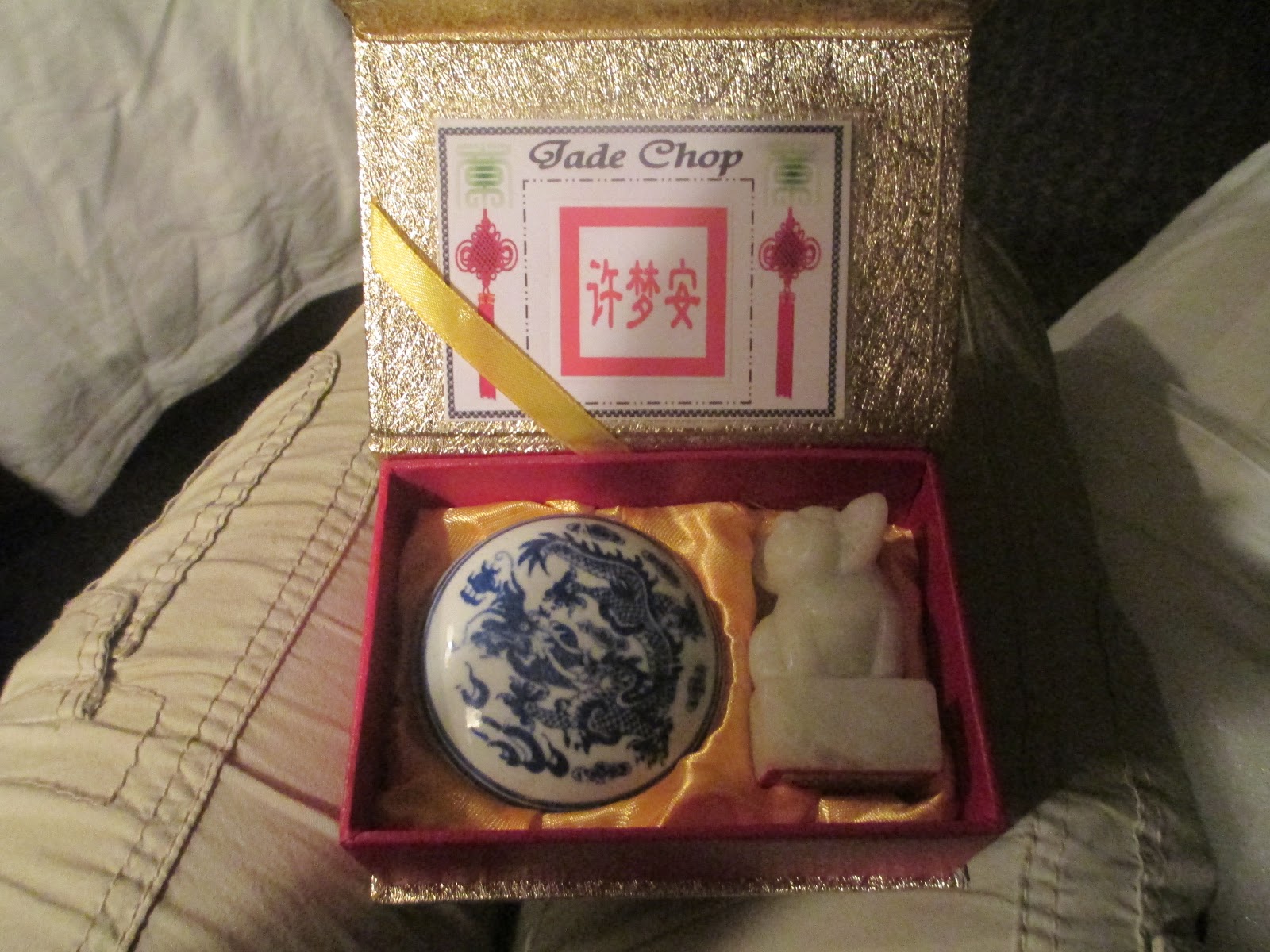

On the left is the red ink, and on the left is my seal.


     My worries about food were put to rest: plenty of vegetables were available.  Many students from our delegation were adamant about not eating duck, though.  I was becoming more and more trusting of the foreign food.  Better yet--I was really enjoying Chinese food.  I had only had take-out Chinese food once in my life before, and I had hated it.  This authentic Chinese food was fifty thousand times better. 
     

Monday, December 24, 2012

Culinary School

     After lunch, we drove to a culinary school, which is a vocational school/college.  Once inside the building, we were brought into a small room in order to participate in a tea ceremony. 

 
     The ceremony was held by female students at the school while their teacher supervised. There were two main girls that conducted the ceremony while other students passed out cups and poured the tea. In the photo below, the girl on the left read, in English, a brief history on tea and what types of tea we would be sampling. We tried four types of tea. While her English was articulated and loud, she sounded robotic, even when she was not reading off of the paper. The girl on the right would prepare the tea, pour the tea, et cetera. She was very elegant and graceful in her moves. It was as if she was as elegant as a beautiful swan. It was inspiring to watch.


     After the tea ceremony, our delegation was split into two groups to go to the kitchens and prepare different dishes.  In the group I went to, we made roses out of dough.  We were first under the impression that they were edible; however, they were not.  You could either make yellow or red roses.  Now that I think of it, I find it interesting because red and yellow are both auspicious colors in Chinese culture. 
 
 
     The roses were actually difficult to make.  I am not physically artistic and crafting a rose from modeling dough was frustrating.  First we had small blocks of dough that we had to roll out into flat, round pieces.  Of course, I was the one unfortunate enough to pick out the driest blocks of dough, and had to start over with new dough.  But once I had dough pieces with enough water, the process was much easier. 
      After rolling out the dough pieces, you had to pick one and roll it into the center of the rose.  Then, you had to place other flattened pieces around the rolled ones, expanding it until it looked like the flower part of a rose. 
     When the rose flower was as thick as you wanted it, you would add a leaf to it.  The leaf was rolled out flat like the other flower pieces.  You would use a toothpick to make the indentions to look like a leaf.  Then, when complete, you would stick the toothpick into the rose and voila! Rose is complete.
     Our two groups then switched rooms.  The next activity we had was to make dumplings! ....pork dumplings.... As a vegetarian, I decided to watch as the other delegates made dumplings from scratch.  While watching the other delegates make the dumplings, I spoke with Phoebe.  Turns out she is also a vegetarian!
    
 
     While in the dumpling room, I was shocked to discover that there were two Chinese boys, approximately my age, goofing off.  They would playfully slap each other on the back of the head, would argue over who would collect (and who would cook) the dumplings.  It was childish and completely unexpected, but it also proved a point: People are people literally everywhere you go.  Westerners typically have the assumptions that Asians are studious, hard-working students who make straight-As and never enjoy themselves.  But that's not true! Stereotypes are just stereotypes.  People of any culture can stand outside their stereotype.  That's what makes us human: we are all different from society's expectation. 


Thursday, November 29, 2012

Lunch


       Our next destination was a restaurant for lunch.  The memory of the mother and her child haunted me and I could only nibble on food while listening to those around me chatter. 
       When we entered the restaurant, I noticed how it was such a fine, beautiful restaurant.  After we walked in, our delegation walked upstairs and were separated into four rooms.  In the room I was in, the room was a near perfect square with a table in the center and a window taking up most of the adjacent wall.  There were two elegant, cushioned chairs beside the window.  The floors were carpeted.  It was truly gorgeous.
       I had never been in a five-star (er, four-star?) restaurant before in my life.  The closest I had to anything like this were the graduatioin banquets from fifth and eighth grade.  It was different, being in such a fancy restaurant. 
       The table was situated in the middle of the room and featured a lazy-susan.  A lazy-susan is a turning-table that food will be placed on a circular table.  It makes it easier to access food because you can spin it to the dish you want.
       I had not been looking forward to using the lazy-susan prior to  traveling to China because, traditionally, one would use their chopsticks to pick up food from the plates on the lazy-susan.  I was still a semi-germophobe and sharing dishes with other people's used chopsticks was not appealing to me.  This fear was broken whenever the waiters placed dispensing utensils alongside the dishes. 
        When the dishes came out, I was glad to see some vegetarian options.  There was actually another vegetarian within our delegation, I was happy to learn at lunch.  We also had three options for beverages: Sprite, Coca-Cola, or bottled water.  (Because of the pollution in China, tap water is not safe to drink.  When we traveled places, we always carried bottled water with us instead of refillable water bottles).  The options of Sprite, Coca-Cola, and bottled water became our only beverage choices during lunch and dinner for the next eighteen days.
      
Rice, tofu, cooked cabbage, and asparagus


       Lunch quickly became fun when everyone picked up their chopsticks.  Some could use them with ease, others could not and struggled to pick up anything at all.  It was quite comical.  Some people eventually caved in and asked for a fork.
 
       I had taught myself how to eat with chopsticks when I first entered high school.  I had put them in my right hand and would force myself to pick up food to train myself how to use them.  Often times I would pop a bag of popcorn and eat it with chopsticks.  If the popcorn grew cold before I could finish it, so be it.  I was stubborn in my way to learn how to eat with chopsticks.
       When I was in Chinese class at school, we had a competition with chopsticks.  We had to use chopsticks to pass a ping-pong ball through a line of people then run around the classroom to the finish line without dropping the ping-pong ball.  It was extremely difficult but also tons of fun.  Each team dropped the ping-pong ball several times and the sound of it bouncing against the hard floor resonated within screams and yells within the groups.  It was extremely fun.
        But before we began the game, Zhang 老师 (laoshi, or teacher Zhang) went around to see how everyone held their chopsticks.  To my utter devastation, Zhang 老师 told me that I was holding my chopsticks wrong.  I was shown how to hold them correctly, and I had to reteach myself how to hold chopsticks.  This was a few months before my departure to China.  I was scared that I would never relearn quickly enough to use chopsticks in China. I began to use chopsticks for every meal.  I would be disheartened easily when my meal became cold, and I would revert back to using chopsticks incorrectly to finish my meal.  But eventually I gained the knack of it and I was able, over several moths, to eat with chopsticks properly and efficiently.  To this day I still enjoy eating popcorn with chopsticks.
       After Zhang 老师 had seen how everyone held their chopsticks, she told us something unique.  Where you hold your chopsticks indicates how far away your soul-mate lives.  If you hold them close to the base, your soul-mate will live in the same state, if it's farther up, your soul-mate could live in the same country.  If your hand is toward the middle, your soul-mate will live in a different country.  If your hand is at the top of the chopsticks, your soul-mate would live across the world. 
       When I held the chopsticks the incorrect way, my hand rested at the very top of the chopsticks.  (An indication that my soul-mate lives in China, perhaps? ;) However, when I held the chopsticks correctly, my hand rested just above midway.  Who knows what that means? Maybe I have two soul-mates? Haha.


     After lunch, we were leaving and one of the waiters came in to clean off the table.  As I was about to leave the room, I said 再见(zaijian, or goodbye) to the waiter.  He nodded his head and also said 再见.  I smiled and left the room.
       Before him, every time I said anything in Chinese to someone Chinese, they would reply in English.  It was disheartening and I began to wonder if my Chinese was not good enough.  But when the waiter also said goodbye, I knew that at least he could understand me.  I began to gain more confidence within myself.

Thursday, November 22, 2012

Images to Never Forget

       After exiting the Forbidden City, Phoebe instructed us that we would walk to our bus where it was parked a few blocks away.  She forewarned us that along  our way, we would encounter more vendors as well as beggars.  Phoebe advised us to avoid eye-contact and to not give away money. From previous experiences in the morning, we learned that vendors would sell cheap products for a cheap price.  However, we had not yet seen beggars.  The thought frightened me; I have a soft heart and I cry easily.  I wasn't sure how I would react.  Phoebe instructed us to not look at the beggars.
       Earlier that day, I had learned how to stay away from a vendor's path.  When they wave their products at you, the best thing was to look down at your shoes, shake your head once, and dismiss them lightly with your hand, whispering or mouthing 不要.  They would then move on to another person.  不要, bu yao, translates to "don't want."  It may seem rude to say that, but it's really not.  Most Chinese sentences are short phrases that contain only essential words.
       While we were walking to the bus, we passed a strip of sidewalk that literally held a line of beggars.  I kept my eyes trained on the back of the head of the student in front of me, but I could still hear the beggars begging for money.  There were musicians and singers and people crying and wailing.  I tried to ignore them.
       However, as we veered a corner there was a mother crying, begging for help.  She held her son, a toddler boy who had either passed out or was asleep.  She held her son with both arms, her face desperate for any kind of help.  His head lolled over her right arm, his face was discolored.  He had to be deathly ill.  I quickly looked away, biting down hard on my lip, tears brimming in my eyes. 
       I truly was not prepared for this.  But then again, this is not about me. 
       Yet it touched a cord within me.  Here I was, fortunate enough to be studying abroad in China, while there were people standing and sitting around me who may or may not be able to eat tonight, tomorrow or possibly ever again..... 
       It makes you think about what you have--no matter what you have or lack.  And it's a reason to be thankful.  There is so much in life we take for granted: food, shelter, water, friends, education, you name it.
        The image of the mother with her child is something that has haunted my mind daily since that day.  It's not something you can forget about easily.  And it is not something I want to forget about.  Sometimes you need to be humbled. 

The Gardens of the Forbidden City

       Our final destination within the Forbidden City was the garden.  We walked through the garden so quickly that I was left unable to truly absorb all the facts about the garden; however, I was able to enjoy the beauty of it.  The gardens were solely for the pleasure of the emperor and empress to enjoy.  The garden also follows the laws of feng shui. 
        Feng shui (风水) is the ancient Chinese belief that positive and negative energy flow according to qi (氣).  Qi (pronounced chee)  is the universal energy flow.  In order for there to be positive energy, items are supposed to be organized in a certain way.  This usually means that buildings will be put on high areas, such as hills and the four season should be recognized.  Feng shui is a highly regarded ancient practice that would be facilitated at homes, burial places, in official buildings--practically everywhere.  There are many rules to feng shui, but these are some basic outlines. 
       There were four pavilions inside the gardens: each one representing a different season.  We only visited one of the pavilions. Other elements included ancient stones, beautiful plants, and old trees with interesting shapes. 
        The tour ended too quickly for my taste and we were soon walking out.  It seemed as if we had only been in the Forbidden City for thirty minutes.  I am looking forward to go back sometime and take a leisurely self-tour to explore as I wish. 


Can you find the hidden man below?


Wednesday, November 21, 2012

Inside the Forbidden City

       I have read about the Forbidden City since the summer of 2009. I had studied and read and learnt and imagined myself in the Forbidden City for years. And then there I was: inside the Forbidden City. To describe it? It was like seeing words from a page come to life and engulf thousands of people in a vast culture that could not be contained in mere words. It was like experiencing a recurring dream for years and then one day witnessing the dream coming to life.
       The first thing I noticed while in the Forbidden City was that the place was as colorful as I had read it to be.  Red walls were everywhere, adorned with gold and beautiful crafted designs with hues of blues, greens, purples, yellows, and more.  Now the City is old, and while the designs were once vibrant hues, they are now a dulled-down version of their former glory; however, one can clearly tell that they are still beautiful pieces of art.


Fu Dogs  (pronounced foo as in the band Foo-Fighters) are found all across China, but the two most famous are in the Forbidden City.  Fu dogs are lion statues that can be found at important buildings, residences, and even at temples.  There are two types of fu dogs: male and female.  Male fu dogs will have a paw that rests upon a pearl.  The pearl represents the universe and how males have power and knowledge over the universe.  Meanwhile, female fu dogs will hold their paw over a lion cub, representing the maternal and nurturing side.


This is a male fu dog; under his paw resides a pearl.

This is a female fu dog; under her paw resides a lion cub.
 
       Inside the City were huge basins in which rain water would be collected.  Whenever the City would catch on fire, the servants would use the water collected in the basins to put out the fire.  I saw two children playing by the water basins and had to take a photo.  It was a wonderful scene of innocence.  You can still see the vibrant colors of the architecture:


       Once we were farther in the Forbidden City, our delegation was allowed to split up into small groups of four to explore for a few minutes. The small group I was part of went to the emperor's bedroom.  It was difficult to take good photos of the emperor's bedroom because 1. the room was blocked off 2. many people would swarm by the entrance; one had to push their way through to the entrance in order to take a good photo.   The color yellow was originally reserved only for the emperor's usage.  Remember that this bedroom dates back to when the Forbidden City was in function as a living palace (1368-1912) so the living commodities weren't exactly up-to-date.


       After exploring as small groups, we regrouped in order to visit the gardens of the Forbidden City.  On our way to the gardens, we passed a brick wall that was composed of bricks with a gold coating.  It was a beautiful wall; however, we were pressed for time and could not stop to take many photos. I was fortunate to catch it in passing:


Tuesday, November 20, 2012

A not-so-forbidden Forbidden City

     The Forbidden City was named such because during the Ming and Qing dynasties (1368-1912), the city was forbidden to commoners. If a commoner were to enter into the city, the punishment was death. The Forbidden City was made open to the public in the year of 1925.
     So what was in the Forbidden City? During the time of its use (1406-1924), the City held the emperors and empresses of China. At any point in time, the City could hold five thousand people: one thousand royal family members, two thousand concubines (female servants), and two thousand eunuchs (male servants).
      An interesting fact about the Forbidden City: it once held 999 1/2 buildings.  According to the Chinese culture, one thousand is the number of Heaven, and the emperor was regarded as the Son of Heaven so he was to have the next/closest-thing to what Heaven had.  999 1/2 was as close to one thousand as one could be.  The half of a building was a small building the eunuchs used.  Due to wars and demolitions, there are no longer 999 1/2 buildings in the Forbidden City.
       (If you want to learn more about the Forbidden City, or want to see it in action, I highly recommend that you watch "The Last Emperor").
      While we walked toward the Forbidden City, there were multiple vendors trying to sell us things.  Vendors were far from shy; they would come right up to you and wave their products in your face, while saying prices in a very loud voice.  We often heard, "One dollar, one dollar, one dollar" throughout the morning. They had everything from postcards to fans to noisy toys, and many other items.  The woman in the bright hat below was a vendor:

     As our delegation entered into the first few city gates, Phoebe (our delegation manager) asked if anyone wanted to go the Happy Room. It took a dumb second for us to understand that Happy Rooms meant Restrooms.
     Yes, I do have a few more restroom stories to share:
     Number One: Originally, there were no  restrooms in the Forbidden City. Chamber pots would be facilitated by the eunuchs. There's actually a gate that had the sole purpose for waste management to leave the City.  It was called "The Gate of Excrement."
      Restroom story number two! (No, not THAT number two!). Because the Forbidden City lacked restrooms, the government built restrooms off to the side for public usage.  We went to use them and I discovered squatty potties.... Squatty potties are literally a hole in the ground with grippers on the sides of the hole for stability. 
     The thing about me is that I have no balance.  And if I were to attempt to use a squatty-potty, I would fall.  And that is totally not okay with me!
     Thankfully, the restrooms were split in half: half squatty potties, the other half Western toilets.  Unfortunately, the toilet I used wouldn't flush.  I'll spare you the details of how absolutely horrid the smell was.
     After that experience, we continued into the Forbidden City. 
     When you first enter the Forbidden City, you will pass through large red doors.


      Red has always been a color of significance for the Chinese culture, going all the way back to the origins for the celebration of the Chinese new year.  In essence, red symbolizes good fortune and happiness.  You will find a lot of red items and monuments in China.  Yellow is also a special color for the Chinese.  Originally, yellow was the color solely reserved for the emperor.  If anyone else was caught wearing yellow, the sentence was death. 
       Going back to the doors: If you look at my photos, you will notice that people are rubbing the yellow knobs that are on the doors.  It is good luck to touch the knobs.  I also touched a knob.  It was a very unique and unparalleled feeling. If you have seen Jackie Chan's version of "The Karate Kid," you will remember the scene in which Xiao Dre rubbed as many yellow knobs within his reach really quickly.  That movie scene flashed through my mind as I traced my hand along the faded yellow knobs.  It brought a smile to my face, and it solidified the fact that I was indeed in China.